
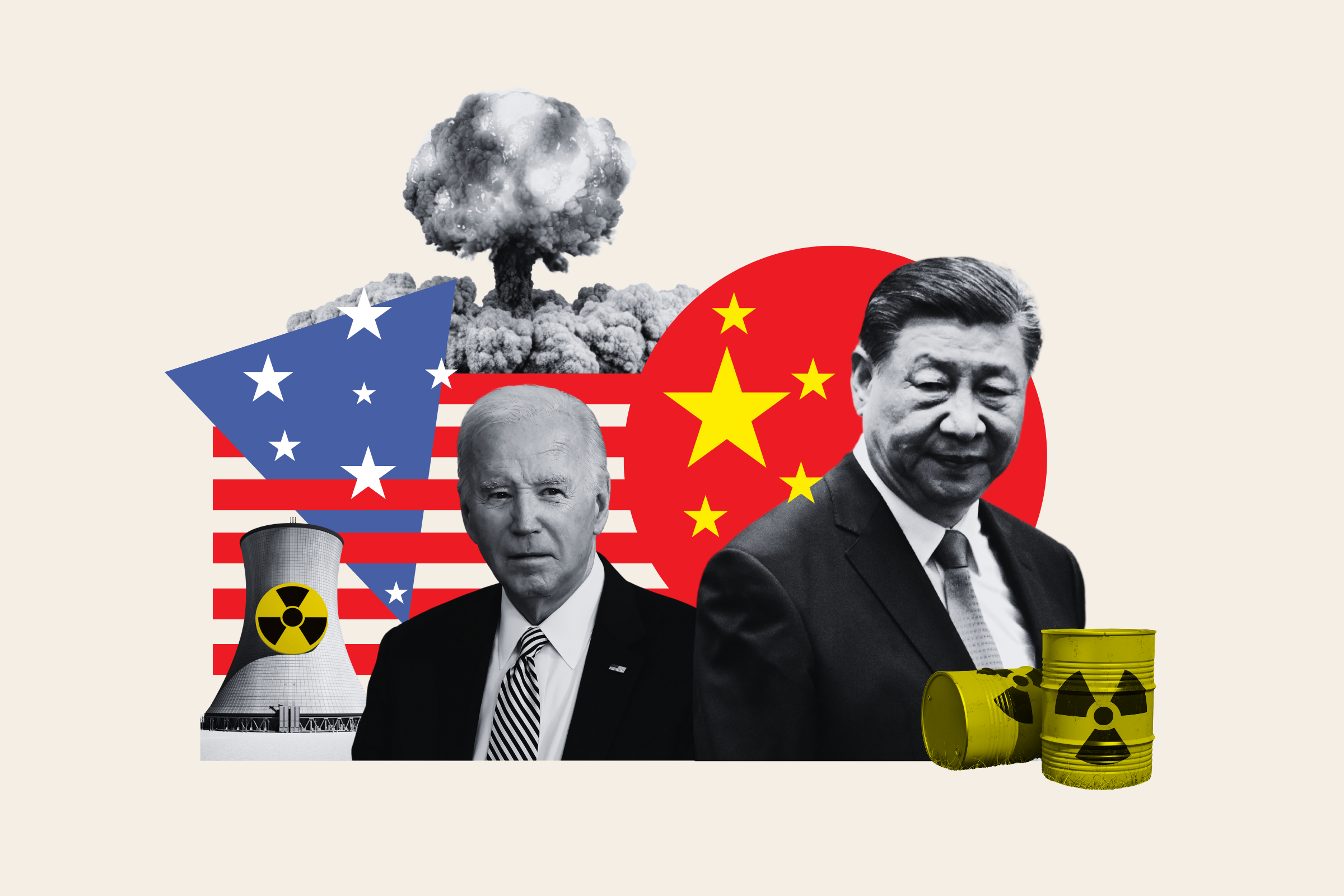
China said this week that it has suspended negotiations with the United States on possible nuclear arms limitations, further hampering already existing nuclear non-proliferation talks at a time when the risks of a new arms race are rising.
In Beijing on Wednesday, Chinese Foreign Ministry spokesman Lin Jian said the decision was taken after Washington undermined its “core interests” by continuing to arm self-ruled Taiwan, the democratically compromised island that China claims as its own.
The announcement, described by an arms control expert as “inexcusable”, comes as China rapidly expands its nuclear arsenal and as the US modernizes its own nuclear triad of strategic bombers, submarine-launched ballistic missiles and intercontinental ballistic missiles.
“In recent weeks and months, despite China’s strong opposition and repeated protests, the US has continued to sell arms to Taiwan and has done things that seriously undermine China’s core interests and the mutual trust between China and the US,” Lin said. .
China has accused the US of compromising the “political atmosphere” for the continuation of arms control talks and has decided to suspend talks for a new round of talks. “The responsibility lies squarely with the US,” Lin said.
China’s long-ruling Communist Party has a stated goal of “uniting” Taiwan with the Chinese mainland, by force if necessary. The US, meanwhile, has been Taipei’s biggest arms supplier for decades and is bound by US domestic law to help Taiwan defend itself.

Mark Schiefelbein/AP Photo
“China’s reasoning for rejecting talks with the United States on nuclear risk reduction and arms control is murky and likely involves little more than irritation over US arms sales to Taiwan,” said Daryl Kimball, executive director of the Arms Control Association.
“It could be that leaders in Beijing did not see much benefit from the risk-reduction proposals presented by the United States at their last meeting in November 2023, or it could be that China simply wants to continue increasing the size of of her arsenal. an assured nuclear retaliatory force before engaging the United States,” Kimball said Newsweek.
US State Department spokesman Matthew Miller said China’s “unfortunate” decision undermined strategic stability between the two countries. “China has chosen to follow Russia’s lead in arguing that engagement in arms control cannot proceed when there are other challenges to the bilateral relationship.”
Regarding future arms sales to Taiwan, Miller said, “We will continue to make those efforts in the face of Chinese threats to their security.”

US Department of State
Last year, President Vladimir Putin suspended Russia’s participation in the New START Treaty, the last remaining arms control agreement between the US and Russia, which expires in February 2026.
When it entered into force in 2011, the agreement limited both countries to no more than 1,550 deployed nuclear warheads and 700 deployed ballistic missiles and bombers.
Moscow has rejected further negotiations, citing Washington’s “destructive stance” on bilateral relations, Russian Deputy Foreign Minister Sergei Ryabkov said earlier this month.
In May, Bonnie Jenkins, the US undersecretary of state for arms control, told the Senate Foreign Relations Committee that Beijing had not provided a “substantial response” to Washington’s proposals to reduce the risk in their last round of negotiations in November and refused to follow -to the meeting.
China has more than 500 nuclear warheads in operational condition, the Defense Ministry’s China Military Power Report said last year. The Pentagon has also estimated that China’s nuclear arsenal will expand to more than 1,000 warheads by 2030.

John Turner/US Air Force via AP
“The refusal of Russia and China to engage with the United States on nuclear risk reduction and arms control at a time of increasing nuclear risk is inexcusable, contrary to the obligations of the Treaty on the Non-Proliferation of Nuclear Weapons, and is long-term , not to themselves. – interesting,” Kimball said.
“Without new limits on US and Russian strategic nuclear arsenals before New START expires, and without some nuclear restraint on the part of China, which is currently building its arsenal, there is a serious possibility of an expensive, dangerous nuclear three-way . an arms race that will produce no ‘winners’ but only ‘losers,’” he said.
Kimball said further communication to avoid misunderstanding in a crisis remains the best strategy to ensure “negotiable limits on nuclear and strategic capabilities.”
“By showing interest in negotiations and serious proposals that address the concerns and interests of both sides, we can also better demonstrate that we are part of the solution and not part of the problem,” he said.
On Friday, the US Department of Energy’s National Nuclear Security Administration declassified its nuclear weapons stockpile for September 2021 through September 2023.
It was a move to show US “leadership, transparency and commitment” to the 1968 Treaty on the Non-Proliferation of Nuclear Weapons, said Jenkins, a US arms control official.
At the end of fiscal year 2023, the US had 3,748 operational nuclear warheads, 40 more than recently is appreciated by the Federation of American Scientists, a Washington think tank that has repeatedly called for similar disclosures.
FAS estimated that Russia had 4,380 operational warheads, for an estimated global stockpile of more than 12,000, including more than 1,000 in respective US and Russian stores that have been retired but not yet dismantled.
“Information also shows that the United States dismantled only 69 retired nuclear warheads last year, the lowest number since 1994,” said Hans Christensen, director of FAS’s Nuclear Intelligence Program. He wrote on Saturday.
“Excessive nuclear secrecy breeds mistrust, fuels worst-case planning, and enables hard-liners and disinformers to exaggerate nuclear threats,” he said.
In a separate report released last month, the Stockholm think tank International Peace Research Institute said China may have put some of its nuclear weapons — possibly about two dozen — on high operational alert for the first time.
In response, Lin, the foreign ministry spokesman, said China maintains a no-first-use policy and limits its nuclear capabilities to the “minimum level necessary for national security.”
Uncommon Knowledge
Newsweek is committed to challenging conventional wisdom and finding connections in search of common ground.
Newsweek is committed to challenging conventional wisdom and finding connections in search of common ground.


Leave a Reply