
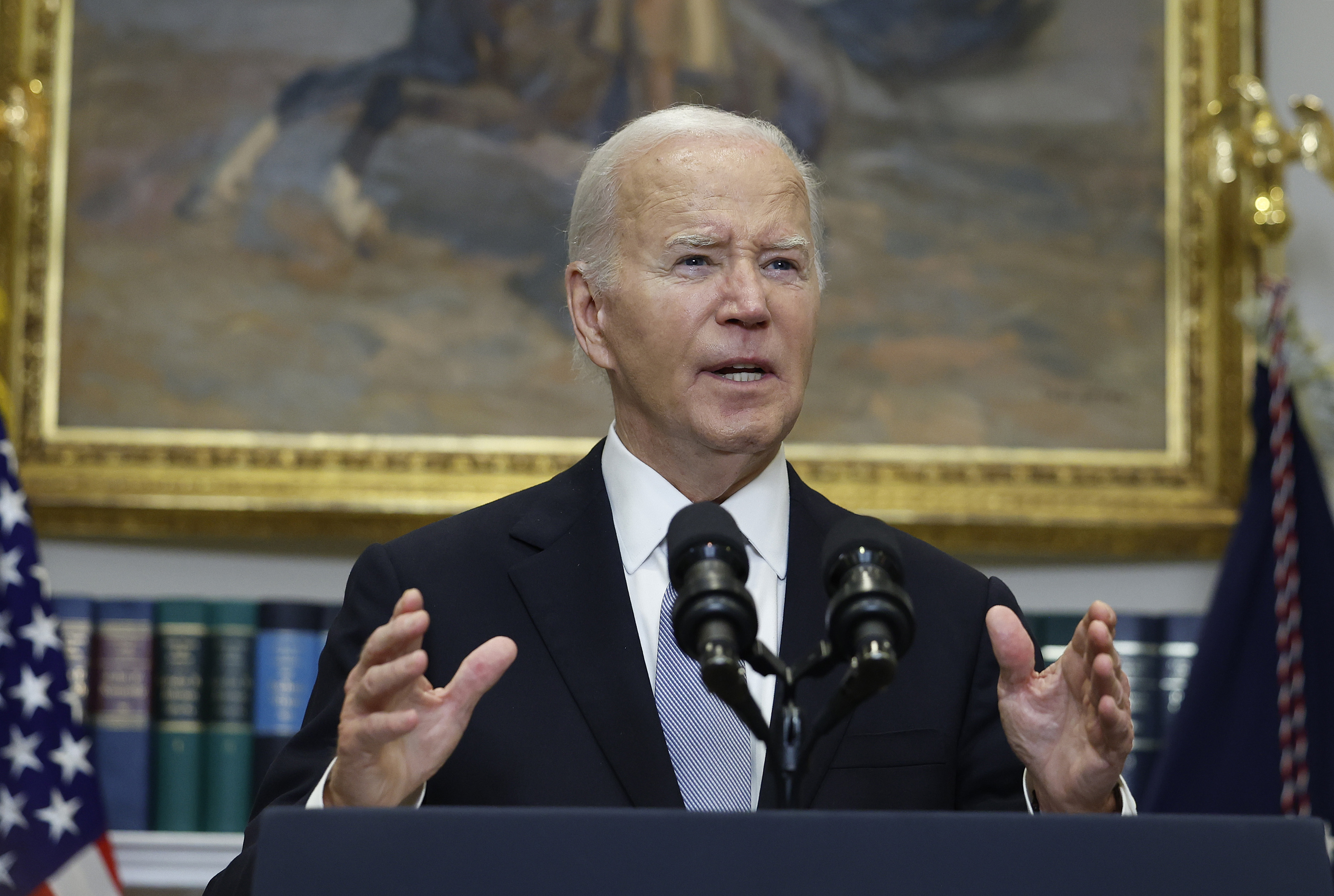
President Joe Biden’s political career has come to an end after more than half a century of public service.
Biden announced on Sunday that he would no longer seek re-election, dropping out of the Democratic Party’s nomination months before Election Day. His withdrawal from the presidential race brings to an end his 54 years of public service, ending a political career that included more than three decades in the Senate and three terms in the White House, two as vice president.
Biden’s exit from the race comes after weeks of calls for him to step down. His poor performance in the June 27 debate against former President Donald Trump sparked internal panic among Democrats as members of Biden’s party began to speculate whether the 81-year-old president was fit to serve a second term.

Kevin Dietsch/Getty
In the last week, the chorus has grown louder. Nearly two dozen lawmakers have publicly called on Biden to drop out of the race. Even some of Biden’s allies in Congress questioned whether he should be the nominee.
Biden has resisted the pressure for weeks, defiantly insisting he will remain in the race. But as he comes to terms with the final months of his term in office, here’s a look at his political career:
Member of the Prefectural Council
Born on November 20, 1942, Biden grew up in a working-class Irish Catholic family. After completing his undergraduate degree at the University of Delaware and graduating from Syracuse University School of Law, he briefly worked as a public defender before running for office at age 28.
Biden ran his first political campaign in 1970 and successfully won election to the New Castle County Council in Delaware, where he served for two years before deciding to enter national politics.
US Senator
In 1972, Biden became one of the youngest senators in US history after defeating Senator J. Caleb Boggs, a popular two-term Republican.
His campaign was a gamble. Just 29 at the time of the race, Biden would have to wait until his 30th birthday in November before taking his seat. He also had minimal campaign funds and staffed his campaign with family members who reached out to Delaware voters. Despite trailing Boggs by nearly 30 percentage points in the months leading up to the election, Biden won with 50.5 percent of the vote.
But a few weeks after his victory, tragedy struck the Biden family.
In December 1972, a tractor-trailer plowed into the station wagon carrying his wife, Nilia, and three children — Bo, Hunter and Amy. His wife and daughter were killed. Beau, 3, and Hunter, 2, were seriously injured. Biden considered resigning after the incident, but his colleagues convinced him not to.
In January 1973, he was sworn in as the seventh youngest senator in American history. As a freshman senator, he was vocal about his dislike of President Richard Nixon and strongly criticized President Gerald Ford in favor of Nixon after he resigned. In 1976, Biden became the first senator to endorse Jimmy Carter for president in the Democratic primary.

Howard L. Sachs/CNP
As a senator, he served in leadership roles on the Senate Judiciary Committee and the Senate Foreign Relations Committee.
In his 17 years as chairman or member of the Judiciary Committee, Biden presided over the confirmation hearings of five US Supreme Court justices, including the contested hearings for Robert Bork and Clarence Thomas, and was instrumental in the passage of the Audit and Act on the Violent Crime Enforcement Act of 1994 and the Anti-Drug Abuse Act of 1986.
He also served as chairman or member of the foreign policy committee for 11 years, during which he supported NATO expansion and pushed for US military intervention in the Balkans. He initially supported the Iraq war, but later became a critic of the Bush administration’s handling of the war.
Over six consecutive terms as a senator, Biden served a total of 36 years in the Senate.
Vice Presidency
Biden has always aimed for higher office. He ran for the Democratic nomination for president in 1988 and 2008, but never won, despite being considered a strong candidate with a moderate image.
In August 2008, however, Biden had a shot at the White House after Barack Obama selected the Delaware Democrat as his running mate. When approached, he presented a very specific idea of how he wanted to shape his vice presidency, acting as the president’s chief adviser and consulting on every critical decision.
Biden became the 47th vice president of the United States in January 2009.
During his vice presidency, he focused on economic recovery after the 2008 financial crisis, foreign policy and domestic issues. Biden also helped Obama secure enough votes in Congress to pass the Affordable Care Act, one of the most significant and defining achievements of the Obama presidency.

Scott Olson/Getty
Biden served alongside Obama in the White House for two terms. Obama surprised his vice president in January 2017 by awarding him the Medal of Freedom in the administration’s final days.
Presidency
Biden launched his third bid for the White House in April 2019, just two years after stepping down as vice president.
His 2020 campaign got off to a rough start. Biden saw disappointing results in the cycle’s early primaries in Iowa and New Hampshire, and it wasn’t until the February primary in South Carolina that he won decisively and emerged as the presumptive Democratic nominee.
Biden was in a tight race against Bernie Sanders until the Vermont senator suspended his campaign in April 2020. Biden officially accepted the Democratic nomination for the convention in August 2020, days after Kamala Harris was announced as his running mate. .
In November, Biden defeated President Donald Trump in a contested race that led to the Capitol Hill riot on January 6, 2021.

Patrick Semansky/Getty
Inaugurated in January 2021, Biden’s presidency began in the shadow of the COVID-19 pandemic, economic instability and deep political polarization. Initially, he focused on COVID, launching a national vaccination campaign and passing the American Rescue Plan. He also signed other important pieces of economic legislation, including the Infrastructure Investment and Jobs Act, the Chip and Science Act, and the Inflation Reduction Act.
On the international front, he faced a number of difficult foreign policy issues, including Russia’s invasion of Ukraine on February 24, 2022, and the Israel-Hamas war that began on October 7, 2023. Biden also ordered a US withdrawal from Afghanistan in 2021. — a decision that would send his approval rating underwater for the remainder of his presidency.
Final Days
Despite the criticism Biden has faced over the past month, he has remained resistant to calls to suspend his campaign.
In a nationally televised interview in July, Biden threw down the gauntlet to his critics, telling them, “Go ahead. Challenge me at the convention.” He also wrote a letter to congressional Democrats assuring them that “I would not run again if I did not absolutely believe that I was the best person to beat Donald Trump in 2024.”
But even after an assassination attempt on his Republican opponent on July 13, Biden’s age and mental capacity remained at the forefront of the debate. However, he remained determined to win re-election, telling BET in an interview on July 16 that the only thing that would cause him to reconsider his candidacy would be a “medical condition.”
A day later, the White House announced that Biden had tested positive for COVID, a diagnosis that would remove him from the campaign at a critical moment in the race.
Four days later, Biden announced he would drop out of the race.
Uncommon Knowledge
Newsweek is committed to challenging conventional wisdom and finding connections in search of common ground.
Newsweek is committed to challenging conventional wisdom and finding connections in search of common ground.


Leave a Reply