
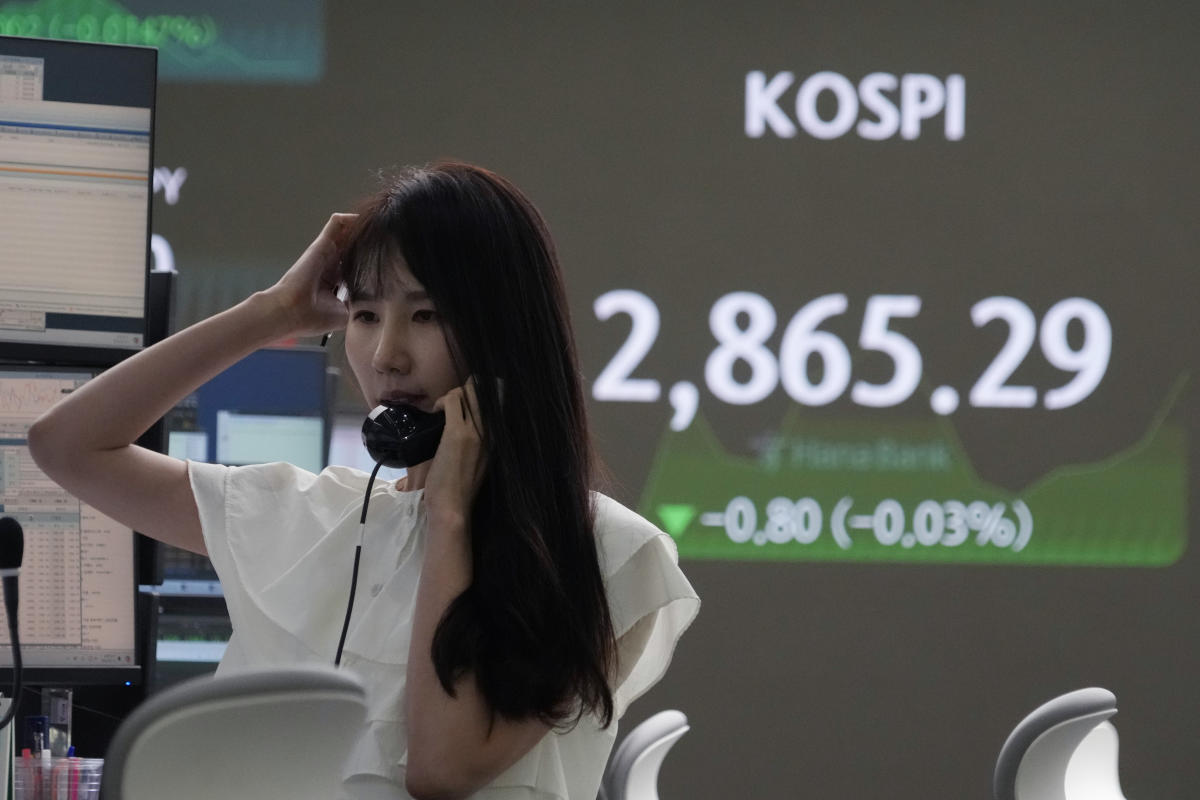
Asian shares were mostly lower on Wednesday, even as investors bet the Federal Reserve will cut interest rates and Australia’s benchmark hit a fresh record.
US futures fell and oil prices rose.
In Tokyo, the Nikkei 225 gave up early gains to fall 0.4% to 41,097.69. Reports said the finance ministry may have intervened in the foreign exchange market last week, buying nearly 6 trillion yen ($37 billion) to prop up the yen.
The US dollar fell to 157.79 Japanese yen from 158.34 yen on Wednesday. The yen fell to 161.85 to the dollar last Wednesday and rose to 157.89 last Friday.
Australia’s S&P/ASX 200 rose 0.7% to 8,057.90 after hitting a record high of 8,083.70 in morning trade. South Korea’s Kospi fell 0.8 percent to 2,843.29.
Hong Kong’s Hang Seng rose 0.2 percent to 17,761.66, while the Shanghai Composite lost 0.3 percent to 2,967.32.
Elsewhere, Taiwan’s Taiex fell 1 percent, with Taiwan Semiconductor Manufacturing Company shares down 2.4 percent. The SET in Bangkok rose 0.2%.
On Tuesday, the S&P 500 climbed 0.6% to 5,667.20, hitting an all-time high for the 38th time this year. Unlike other record days, Tuesday came after an extended rally in which nearly nine out of 10 stocks in the S&P 500 rose, rather than the handful of influential Big Tech stocks which was behind most of this year’s returns.
The Dow Jones industrial average jumped 1.9 percent to 40,954.48 and the Nasdaq composite lagged 0.2 percent to 18,509.34 as the stars fell for some of the biggest winners of the year.
Several big winners from the previous day, which benefited from increased expectations for former President Donald Trump to retake the White House, they reversed some of their immediate leaps after Trump’s bypass attempted murder during the weekend.
Trump Media & Technology Group fell 9.1%, a day after jumping 31.4%. Company shares behind Trump’s Truly Social The platform regularly moves by large percentages every day, up or down.
In the bond market, some of the previous day’s moves were also reversed. Longer-term yields fell more than short-term yields after a report sales to US retailers last month despite economists’ expectations of a decline.
The yield on the 10-year note fell to 4.16 percent from 4.23 percent late Monday. That’s down from 4.70% in April, which is a major move for the bond market and has given a strong boost to share prices.
Yields fell due to rising expectations that inflation is slowing enough to convince them The Federal Reserve begins cutting interest rates soon. The Fed is keeping its key interest rate at its highest level in two decades in hopes of slowing the economy enough to bring inflation fully under control.
Tuesday’s stronger-than-expected retail sales data may give Fed officials some pause because overly strong activity could keep upward pressure on inflation. However, traders are still betting on a 100% chance that the Fed will cut its key interest rate in September, according to CME Group data. A month ago, they saw a 70% chance.
Risks lie on both sides of the tightrope the Federal Reserve is currently walking. The central bank is hoping to ease the brakes on the economy through high interest rates at just the right time. Easing too soon could allow inflation to pick up again, but easing too late could trigger a recession. Tuesday’s retail sales data points to an economy that remains resilient so far.
In other trade, benchmark U.S. crude oil added 1 cent to $79.72 a barrel in electronic trading on the New York Mercantile Exchange.
Brent crude, the international standard, fell 8 cents to $83.65 a barrel.
The euro rose to $1.0912 from $1.0898.
___
AP Business Writer Stan Choe contributed.


Leave a Reply