
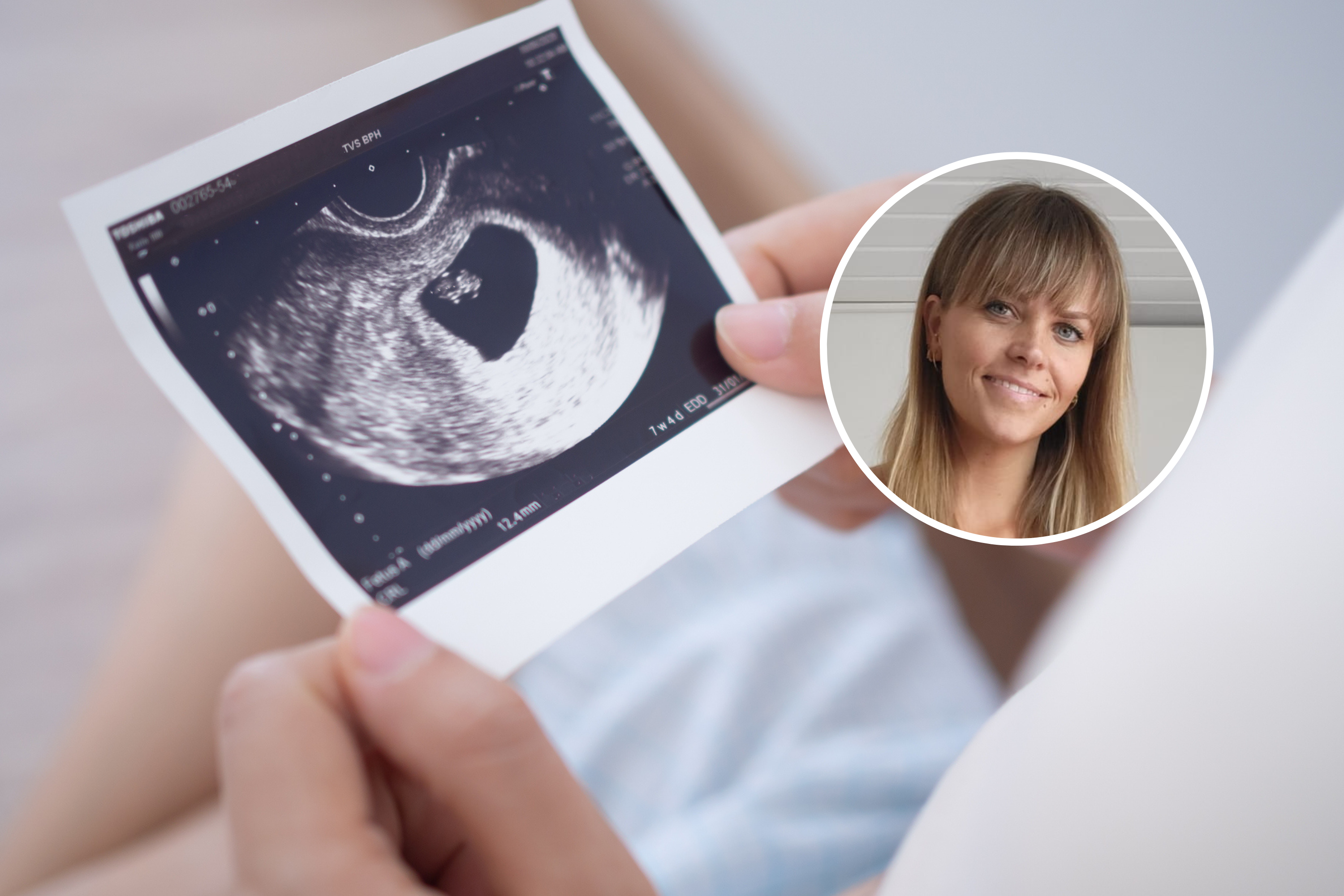
After losing three babies in successive pregnancies, Pernille Burgdorf felt hopeless.
“We had lost three sons who were healthy,” said the mother of two from Jutland, Denmark. Newsweek. “The doctors couldn’t find anything wrong with them.”
Each baby had been born prematurely. “We lost the first in Week 27, the second in Week 17 and the third in Week 23,” Burgdorf said.
During each pregnancy, Burgdorf experienced severe vaginal discomfort. “I had this heavy discharge and constant itching and stinging,” she said. “It was also very embarrassing for me.”
Desperate for answers, Burgdorf and her husband researched her symptoms online and found they were consistent with symptoms of bacterial vaginosis.

Pernille Burgdorf
Bacterial vaginosis is an infection caused by changes in the billions of microbes that live in the vagina, known as the vaginal microbiome.
A healthy vaginal microbiome is usually dominated by Lactobacillus bacteria, which play an important role in protecting their host from infection and maintaining optimal conditions within the bay. However, due to a variety of factors—including antibiotics, douching, and transmission from sexual partners—the vaginal microbiome can become unbalanced and overrun by “bad” bacteria, resulting in vaginitis.
According to the World Health Organization, more than 1 in 5 women experience vaginitis at some point in their lives, although 50 percent of cases are asymptomatic. The condition has also been associated with a number of reproductive health issues, including lower chances of conception during IVF, increased risk of healthy pregnancy loss and premature births.
“I asked [my doctors] if they could test me for bacterial vaginosis, but they didn’t see a reason to,” Burgdorf said. “I felt like the doctors were telling me I was stupid.”
In August 2021, Burgdorf went to the recurrent pregnancy loss clinic at Hvidovre Hospital in Copenhagen.
“When we first went [to the clinic] I felt like we had tried everything,” Burgdorf said. “But both me and my husband decided to give it a go.
At the clinic, Burgdorf met Dr. Henriette Svarre Nielsen, professor and gynecologist consultant at the University of Copenhagen and head of the clinic for recurrent pregnancy loss.
“We were actually in the middle of a larger randomized controlled trial to investigate the benefits of transplanting vaginal microbes from healthy donors to treat vaginitis,” Nielsen said. Newsweek. “We had already tested 302 healthy women in the Copenhagen area and had a pre-defined protocol to make sure we didn’t spread any disease.
“All this was going on when Pernille came to my clinic and told us her story.”
Burgdorf was asked to provide a vaginal sample for further testing and, six days later, received a phone call from the nurse. Ninety percent of Burgdorf’s sample was dominated by a bacterium called Gardnerellaknown culprit of bacterial vaginosis.
“For the first time, someone was actually saying, ‘You’ve been right all along,’” Burgdorf said. “They asked me if I wanted to do patient zero for their vaginal microbiota transplant. And for the first time I thought, ‘I can find the answer, but I can also be an answer for so many other women and families who have lost children.’”
After selecting a suitable donor, the team, led by then PhD Tine Wrønding, administered Burgdorf’s vaginal microbiome transplant. They expected to deliver several rounds of treatment before her symptoms cleared up. But it wasn’t like that.
“The amazing thing was, after a week, she called us and said she was symptom-free,” Nielsen said.
Burgdorf added: “I don’t think anyone could have hoped for a better result. But I was also so angry: ‘Is that all I needed?’ We buried three boys and they died of bacteria?”
Five months later, Burgdorf became pregnant. “I had no symptoms at all,” he said. “I just felt like a whole new woman.”
However, within six weeks, the Gardnerella had returned. “We were so scared,” Nielsen said.
The team rushed to collect a second vaginal sample from the donor and set up an appointment with Burgdorf. But to everyone’s relief, by the day of the appointment, Burgdorf’s microbiome had returned to its healthy post-transplant state.
“She really had the power to turn it around on her own,” Nielsen said.
Although it was a tense and stressful time, Burgdorf said the pregnancy went “perfectly” and she gave birth to a healthy baby boy.
It has now been 19 months since her “miracle” baby, Erik Mario, came into the world. “I have no doubt in my mind that it must have been [the transplant,]Burgdorf said.

Pernille Burgdorf
However, while Nielsen is “super excited” by these results, she cautioned that it is too early to say that the transplant alone was responsible for Burgdorf’s pregnancy success.
“We need more evidence to confirm this,” he said. “All we can say with absolute certainty is that her symptoms disappeared and that her [transplanted microbes] have persisted in her body. However, it is impressive that you can give a donor this transplant and she is able to continue to menstruate, get pregnant, deliver her baby and continue to have that donor origin. Lactobacillus in the bay. I think it’s pretty amazing.”
Nielsen added that, based on the trial results so far, the treatment doesn’t work for everyone. “It’s like everything else in medicine – some people will benefit, like Pernille, and that’s amazing, but there’s so much more we need to learn to make that happen. [standard] treatment,” he said.
This treatment has not only shown promise in restoring fertility, but may also provide symptom relief for women at the end of their reproductive years. “We know all the problems that happen when estrogen goes down when you go into menopause and there can be some benefits [of microbial transplantation] for vaginal dryness and an increase in infections and all that,” Nielsen said.
In the future, Nielsen hopes the treatment will become more scalable and accessible to patients. “I hope in 10 years they have an artificial version [of vaginal microbiome transplants] because there are so many women who need this treatment,” she said.
“I also think it’s important to discuss that, in a transplant like this, we get everything [from the donor’s microbiome]— we get it [“good”] bacteria but we also get immune factors and many others [beneficial] things along with these germs. [By contrast,] if you take probiotics, introduce only one strain—perhaps two strains—of bacteria. This may explain why we haven’t seen such effective results with probiotics.”
As for Burgdorf, she encourages anyone in a similar position to ask their doctors to test for bacterial vaginosis. “If you have a feeling that something is wrong with your body, stick with it and believe in yourself,” she said. “A test can make a huge difference, not only to the parents’ lives, but to the little life you might lose.”
A new era of healing
Today, bacterial vaginosis is mainly treated with vaginally administered antibiotics. However, while this treatment comes with an 80 to 90 percent cure rate, antibiotic therapy also has some significant drawbacks.
For one, 60 percent of patients see a recurrence of symptoms within the first 12 months after treatment. Second, antibiotics can disrupt the balance of healthy bacteria in the vagina (or in the gut if taken by mouth.) Finally, antibiotic use can lead to the development of antibiotic resistance among the bacteria associated with vaginitis, potentially making it even more difficult situation. cure.
Vaginal microbiome transplantation has been demonstrated once before in a 2019 study in which five women with recurrent vaginitis were treated with vaginal microbiome transplants from healthy donors. However, the grafts were received after pretreatment with antibiotics and there was no evidence of engraftment of the donor bacteria.
What is unique in Burgdorf’s case is the fact that the transplant was performed in the absence of antibiotics, resulting in a long-term change in the bacterial composition of the recipient’s microbiome, including the engraftment and persistence of donor strains.
The full case study can be read in the journal EClinical Medicine.
Is there a health problem that worries you? Let us know via health@newsweek.com. We can ask for expert advice and your story can be featured Newsweek.
Uncommon Knowledge
Newsweek is committed to challenging conventional wisdom and finding connections in search of common ground.
Newsweek is committed to challenging conventional wisdom and finding connections in search of common ground.




Leave a Reply